


Energy Efficiency & Sustainability
EU Anti-Greenwashing Rules 2026: What Thai Hotels Must Know
From 27 September 2026, EU rules ban vague green claims and self-declared hotel badges. What Directive (EU) 2024/825 means for hotels selling to Europe.
Written by


What is the EmpCo Directive?
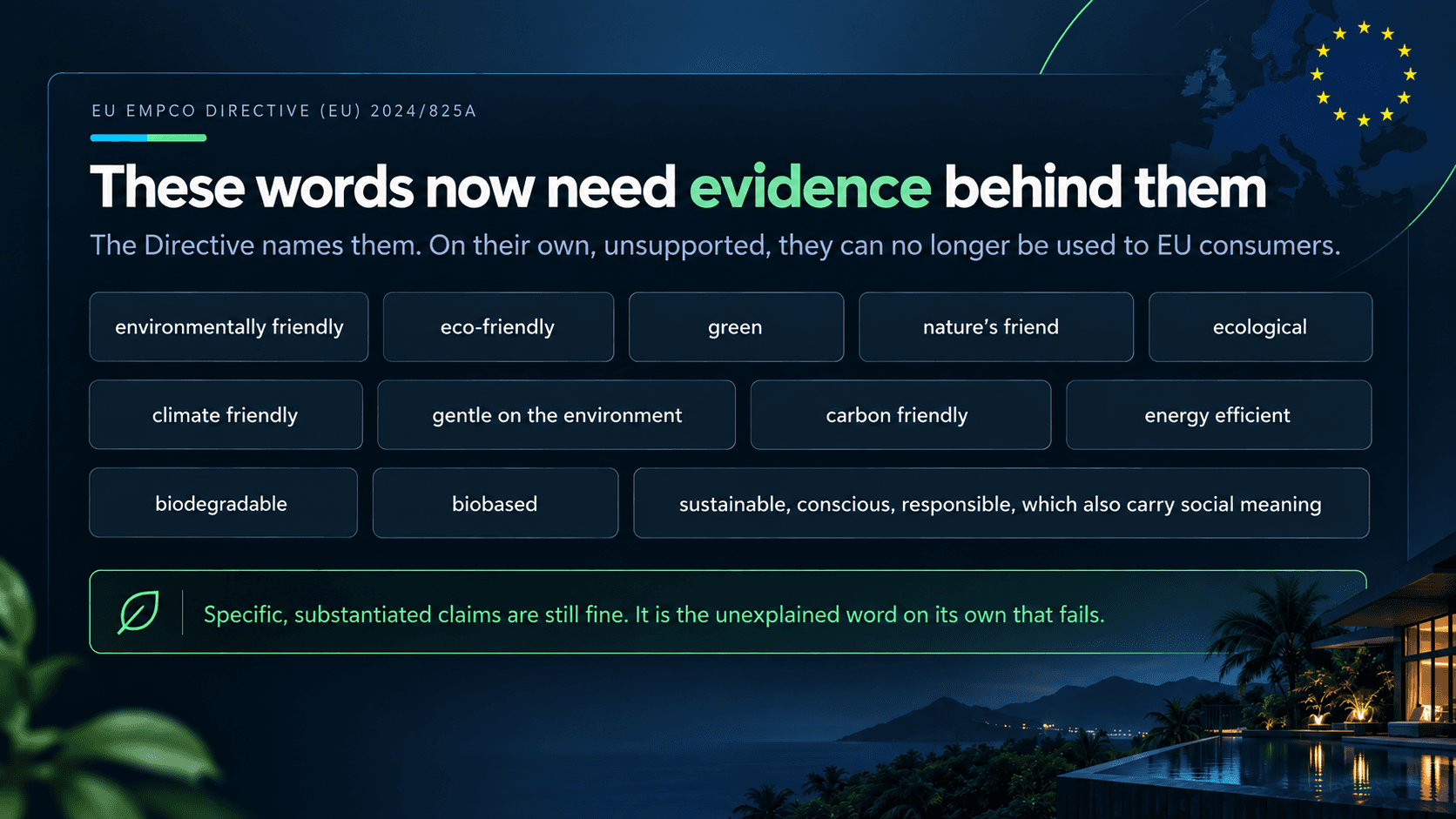
The Directive (EU) 2024/825A or the Empowering Consumers for the Green Transition Directive (EmpCo or ECGT) sets new rules for environmental claims that can be made to EU consumers. The Directive protects consumers from vague or unsubstantiated claims.
Under this Directive, vague environmental claims will be prohibited. Companies will no longer be able to declare that they are ‘green’ or ‘environmentally friendly’ if they cannot demonstrate that they are.
The EmpCo Directive comes into effect on 27 September 2026.
Why this matters for Thai hotels
The EmpCo Directive has implications beyond Europe. Global travel platforms like Booking.com and Expedia, hotel groups, and corporate travel buyers are adapting in response to the Directive.
Thai hotels that rely on European guests and tour operators will be most affected. The exposure sits where green messaging is the loudest, in Phuket, Krabi and Samui resorts selling through European operators, and in MICE venues chasing European corporate business. In 2025, total arrivals to Thailand fell just over 7%, but European markets grew: France up 14.3%, Germany 11%.
The booking platforms were already ahead of this change. Booking.com dropped its own Travel Sustainable badge in 2024 after the Dutch regulator called it misleading, and rebuilt the filter around third-party certification.
According to Booking.com's 2026 Travel & Sustainability Report, travellers booked over 100 million room nights at third-party certified properties on the platform in 2025. A hotel whose certification is not on Travalyst's list, the shared reference booking platforms draw on, will not appear in that filter, losing visibility with guests who are looking for it.
Which certifications still work
To comply with the Directive, the hotel's sustainability certification has to tick all four:
Open to any provider on fair, transparent, non-discriminatory terms
Requirements built with experts and stakeholders
A real procedure for non-compliance, including pulling the label entirely
Checked by a third party independent of the scheme and the hotel
GSTC, Green Hotel Plus, Green Leaf, and Travelife have all declared compliance with these criteria.
How Alto Greenify helps hotels prepare for this change
Regulators, guests and corporate buyers will be asking this: is your hotel really sustainable, and who verified this?
Most hotels are in one of two situations.
No certification yet. | Alto Greenify maps the documents you already have against GSTC Hotel v4.0, GSTC MICE v1.0, Green Hotel Plus, Green Hotel, and Travelife and shows your evidence prep progress for each. Most hotels are further than they expect. |
Already holding a Thai local standard. The useful question is how your existing evidence stands up against a standard that has declared EmpCo compliance. | Alto Greenify scores your audit-readiness and lists the gaps before you commit budget and staff time to an audit. Finding out your hotel’s gaps now can help you decide on which certification scheme to go for and makes the audit process smoother – less time spent on documenting new evidence mid-audit. |
Sources
European Commission, Sustainable consumption: empowering the consumer for the green transition
EUR-Lex, Directive (EU) 2024/825, full text
GSTC, How GSTC Certification Supports Compliance with the EU EmpCo Directive
Travalyst, Certifications Initiative, second iteration list, updated 4 September 2026
Booking.com, Prioritizing third-party certifications, March 2024; and Booking.com 2026 Travel & Sustainability Report
ACM, Booking.com takes 'Travel Sustainable' programme offline following ACM action
Green Key Global, What New Greenwashing Regulations Mean for Hotels and How to Stay Ahead
Keep Reading
Energy Efficiency & Sustainability
From 27 September 2026, EU rules ban vague green claims and self-declared hotel badges. What Directive (EU) 2024/825 means for hotels selling to Europe.

Energy Efficiency & Sustainability
AltoTech Global and QSNCC, with support from TCEB through the MICE Winnovation program, launched the Carbon Footprint Realtime Tracking Dashboard at QSNCC. The platform tracks Scopes 1–3 and enables transparent Carbon Neutral Events, highlighting TCEB’s role in driving Green MICE in Thailand.