


Customer Challenge
"Carbon neutral" usually means a logo. We wanted it to mean a number.
Plenty of events print a green leaf on the banner and call themselves sustainable. Very few can tell you how many tonnes of CO₂ they actually produced, where those tonnes came from, or whether the offset they bought genuinely covered them.
For SITE 2026, that gap was the problem worth solving. An event built around innovation and investment couldn't credibly stand on stage talking about a net-zero future while its own footprint stayed invisible. The brief to AltoTech was direct: make the carbon real. Show the number, show the sources, and show it while the event is still happening, so the claim is defensible to any attendee, partner, or investor who asks.
If you can't see the footprint, you can't shrink it, and you certainly can't prove you offset it. Transparency is the product.
Solution
A live Carbon Dashboard, on the floor, where 10,000 people could see it
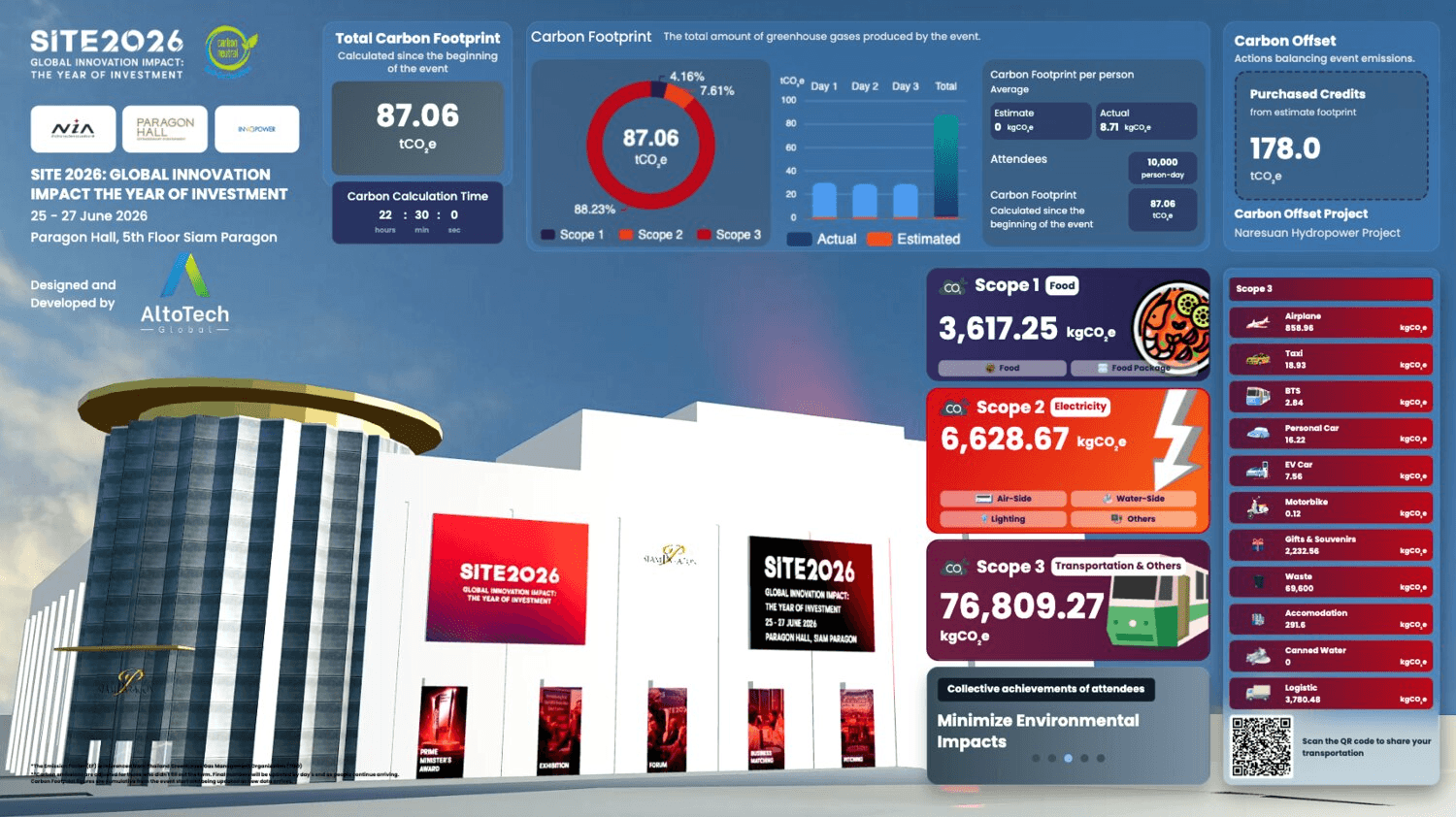
AltoTech deployed its Real-Time Carbon Tracking Dashboard across the venue: large screens and standing kiosks placed along the Paragon Hall concourse so visitors walked straight past the event's running carbon count. Instead of an emissions figure that appears weeks later in a PDF, the footprint was a live, public scoreboard.
Attendees became data sources, not just spectators
A QR code on the dashboard let visitors log how they travelled to the venue. That turned the hardest scope to measure, transport, into a crowdsourced data stream rather than a guess, and it gave attendees a small, visible role in the event's collective footprint.
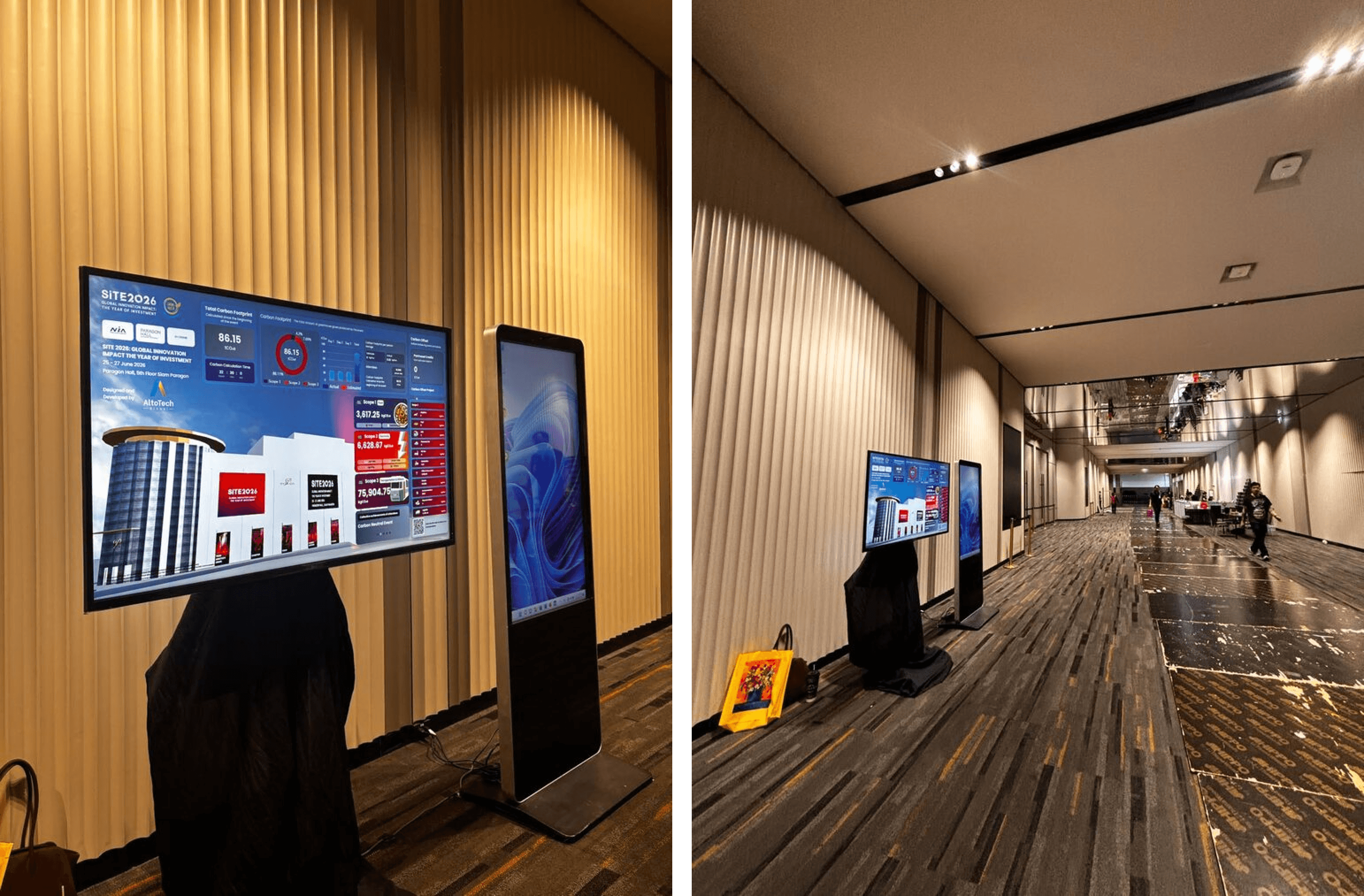
The live dashboard on screens and standing kiosks along the Paragon Hall concourse, carrying the SITE 2026, NIA, Paragon Hall, and Innopower branding, with a QR code attendees scanned to share their travel mode.
Impact
A footprint nobody had to take on faith
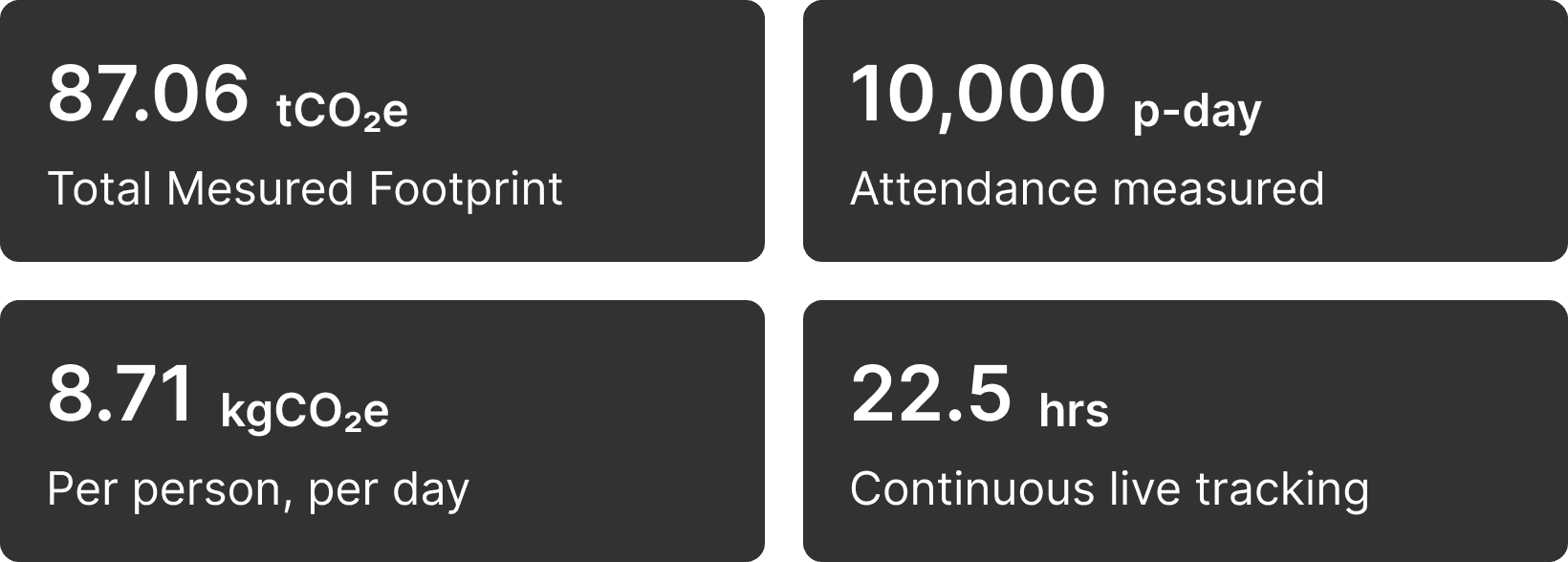
By the close of the event, the dashboard showed a complete, scope-by-scope picture of SITE 2026's carbon footprint, every figure traceable back to a TGO emission factor.
Where the carbon came from
Splitting the footprint by scope did something a single number never can: it pointed straight at the levers that matter for next time.
Scope | Source | kgCO₂e | Share |
|---|---|---|---|
Scope 1 | Food | 3,617.25 | 4.16% |
Scope 2 | Electricity | 6,628.67 | 7.61% |
Scope 3 | Transport & Others | 76,809.27 | 88.23% |
Total | 87,055.19 | 100% | |
SITE 2026 carbon footprint by scope (cumulative, end of event)
The insight worth keeping
Scope 3 dominated at 88% of the total, and within it one line towered over the rest: waste accounted for roughly 69.6 tCO₂e, close to 80% of the entire event footprint, far ahead of logistics (3.78 t), gifts and souvenirs (2.23 t), and accommodation (0.29 t, organizer team records only). Notably, all attendee travel logged through the QR code, from flights to BTS rides, added up to under 1 tCO₂e combined, while electricity and food together made up under 12%.
That is exactly the kind of finding the dashboard is built to surface. For any venue running future events, it converts "be more sustainable" into a concrete target: get waste and logistics right and you remove the overwhelming majority of the footprint.
On the numbers
Emission factors are referenced from the Thailand Greenhouse Gas Management Organization (TGO). Figures are cumulative from the start of the event and were adjusted for attendees who did not complete the travel form. The dashboard reports the measured operational footprint of the event. Accommodation covers the organizer team's hotel stays only, recorded directly by the team, and is not an event-wide lodging figure across all attendees.
From measured to neutral, with Innopower
Measuring the footprint is half the story. Closing it is the other half, and that is where Innopower came in. Innopower offset SITE 2026 in full, purchasing verified carbon credits from the Naresuan Hydropower Project, a renewable-energy source of high-integrity offsets. The completed purchase appears right on the dashboard.

178 tCO₂e carbon credits purchased
Against a measured footprint of 87.06 tCO₂e, Innopower purchased 178 tCO₂e of credits. SITE 2026 wasn't just nudged across the carbon-neutral line. It cleared it with a comfortable, fully documented margin, and the dashboard's offset panel showed the purchased credits right beside the footprint they cancelled out.
A repeatable model for every venue that wants to sell "green" with a straight face
What made SITE 2026 work wasn't a one-off stunt. It was a pairing that any organizer or venue can reuse: a measurement layer that produces a credible, scope-by-scope number in real time, and an offset partner that turns that number into a neutral, verifiable claim.
For a destination like Siam Paragon and Paragon Hall, hosting dozens of exhibitions and forums a year, this is more than a sustainability gesture. It is a sellable feature. A venue that can hand every event organizer a live carbon dashboard and a ready offset pathway is offering something competitors can't: proof. Convention centres, shopping malls, hotels, and exhibition halls across Thailand face the same rising expectation from corporate and government clients to show, not just claim, their environmental performance.
SITE 2026 is the reference deployment. The same dashboard, the same scope methodology, and the same offset partnership can be packaged for the next event, the next hall, and the next anchor tenant, with implementation measured in weeks rather than months.
Let's make carbon footprint measurable.